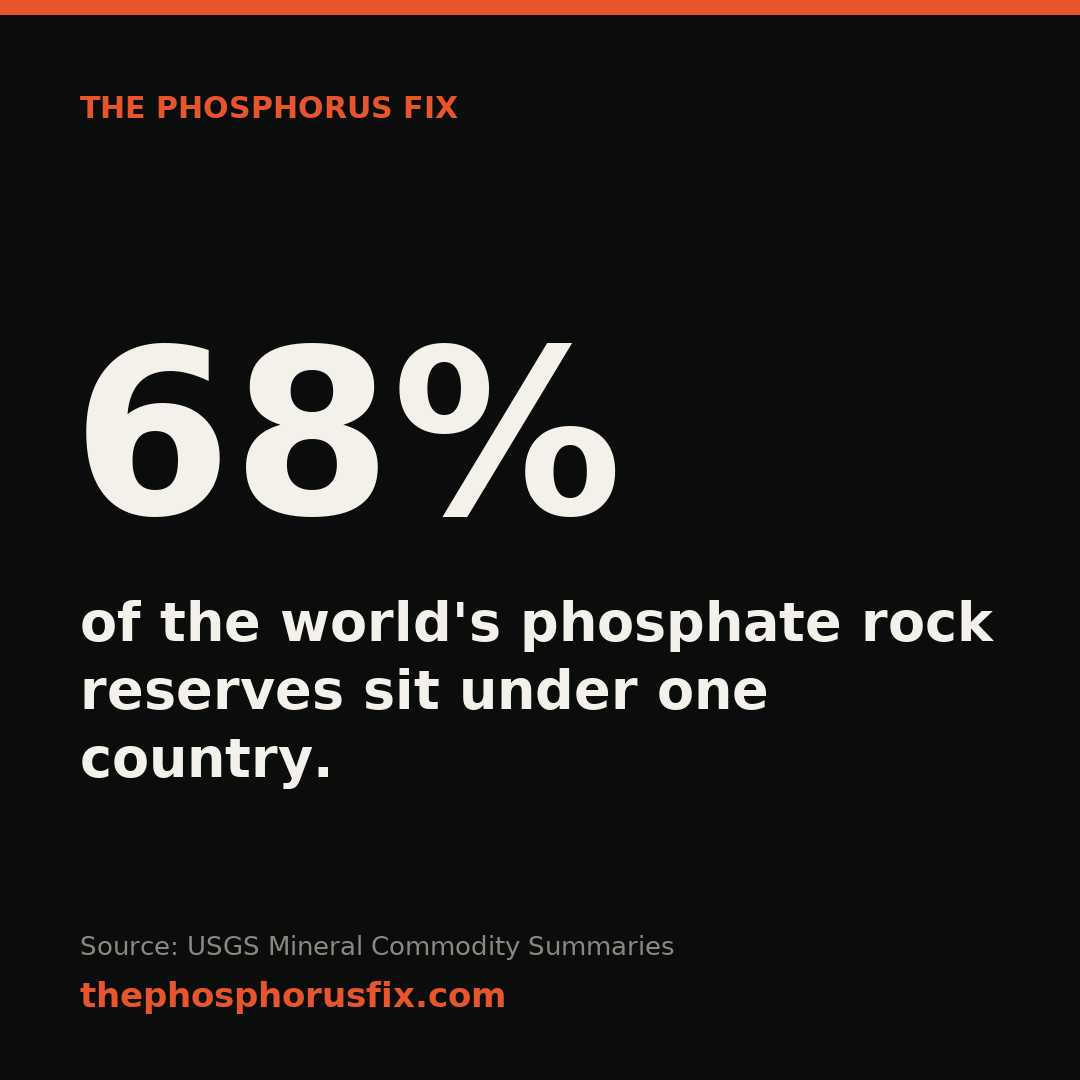
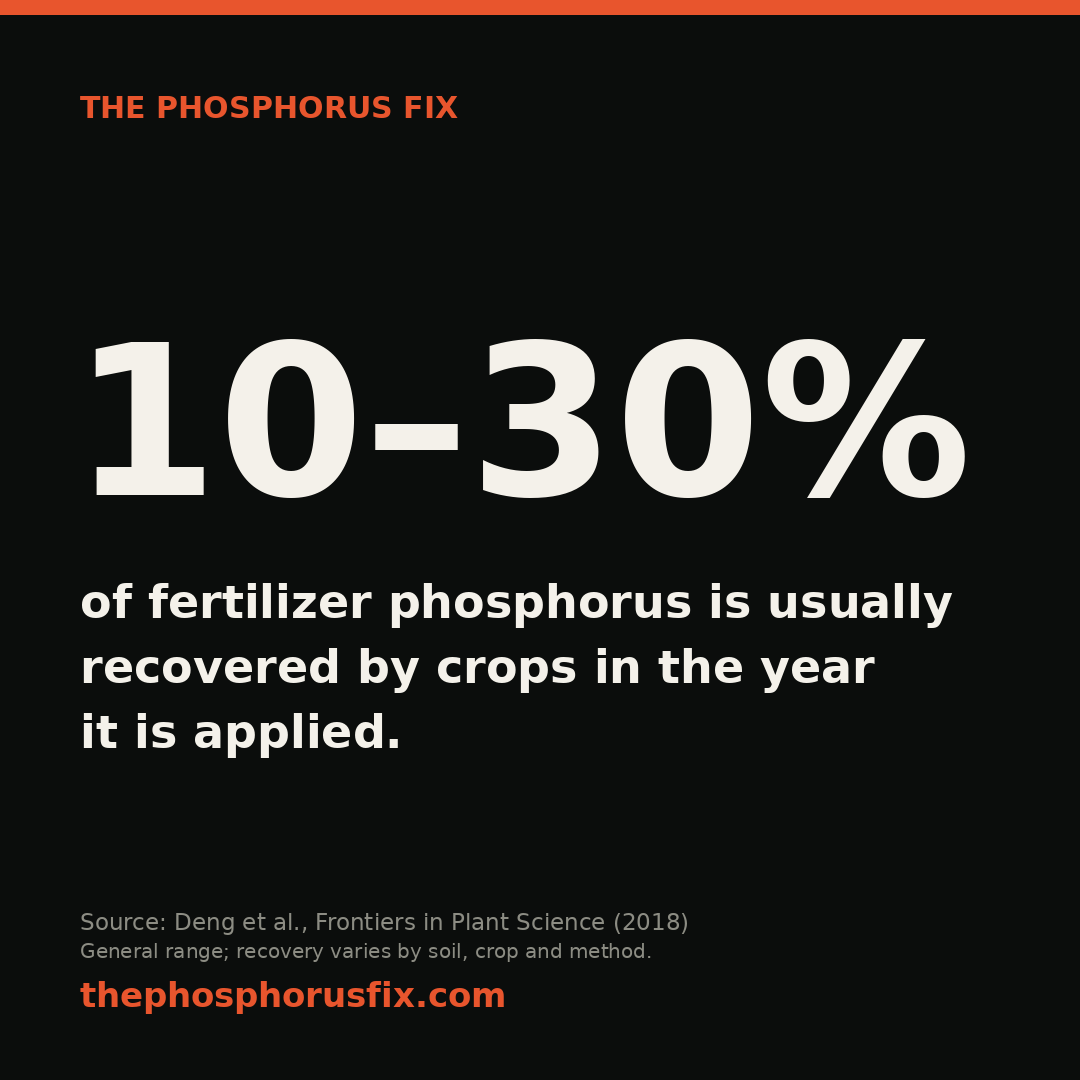
It cannot be manufactured. It has no substitute. It is not recycled at any meaningful scale. Two-thirds of the world's reserves sit under a single country — and four out of every five pounds we apply never reach the crop in the season it's applied.
Seventy-eight percent of the atmosphere is nitrogen — it can be fixed by biology or manufactured anywhere there is energy. That is why nitrogen has innovators, alternatives and a route to independence.
Phosphorus has none of that. Every phosphate molecule a crop uses was mined out of the earth. It builds DNA, cell membranes and the ATP that moves energy through every plant and every person who eats one. Over 90% of mined phosphate rock goes to fertilizer, and there is no laboratory route to more of it.
USGS lists no government stockpile and no substitute for phosphorus in agriculture.
Reserves, not annual production, decide the long game. Most nations on earth have no phosphate rock at all and depend entirely on imports to feed themselves.
In November 2025 the United States formally added phosphate rock to its Critical Minerals List — alongside uranium and boron. Nearly all US phosphate rock imports, about 98%, come from a single country: Peru. Finished phosphate fertilizer has leaned heavily on imports from Morocco and Russia.
China restricts phosphate fertilizer exports. Prices spike worldwide.
Lockdowns close production hubs and snarl global freight.
Gas prices and sanctions send fertilizer to record highs.
DAP passes $700 a metric ton as rock and sulfur exports are cut off.
A farmer in Arkansas cannot hedge a shipping lane. Volatility in this market is structural, not exceptional — and it arrives as a bill.
Of every 100 pounds of fertilizer phosphorus applied, crops usually recover only 10 to 30 pounds in the application year. Much of the remainder bonds to calcium, iron and aluminum in the soil, reducing its immediate availability to roots.
First-season recovery: Deng et al., 2018, Frontiers in Plant Science, introduction. This is a general literature range, not a measured average for all US fields; recovery varies by soil, crop and measurement method. Phosphorus remaining in soil can contribute to later crops.
It is not lost from the field — it is locked in a bank the crop cannot readily draw on. Decades of over-application have built large soil phosphorus reserves in much of the Corn Belt, while the crop still runs short in season. Some residual fertilizer phosphorus can feed later crops.
This is the compounding error. Because so little reaches the crop, programs are built to over-apply — and the system compensates for waste by mining more rock. Inefficiency is not a side effect of the supply problem. It is what is driving it.
Hold the harvest exactly where it is. Now raise the share of applied phosphorus that actually reaches the crop, and watch what America no longer has to mine, ship, burn or lose downstream.
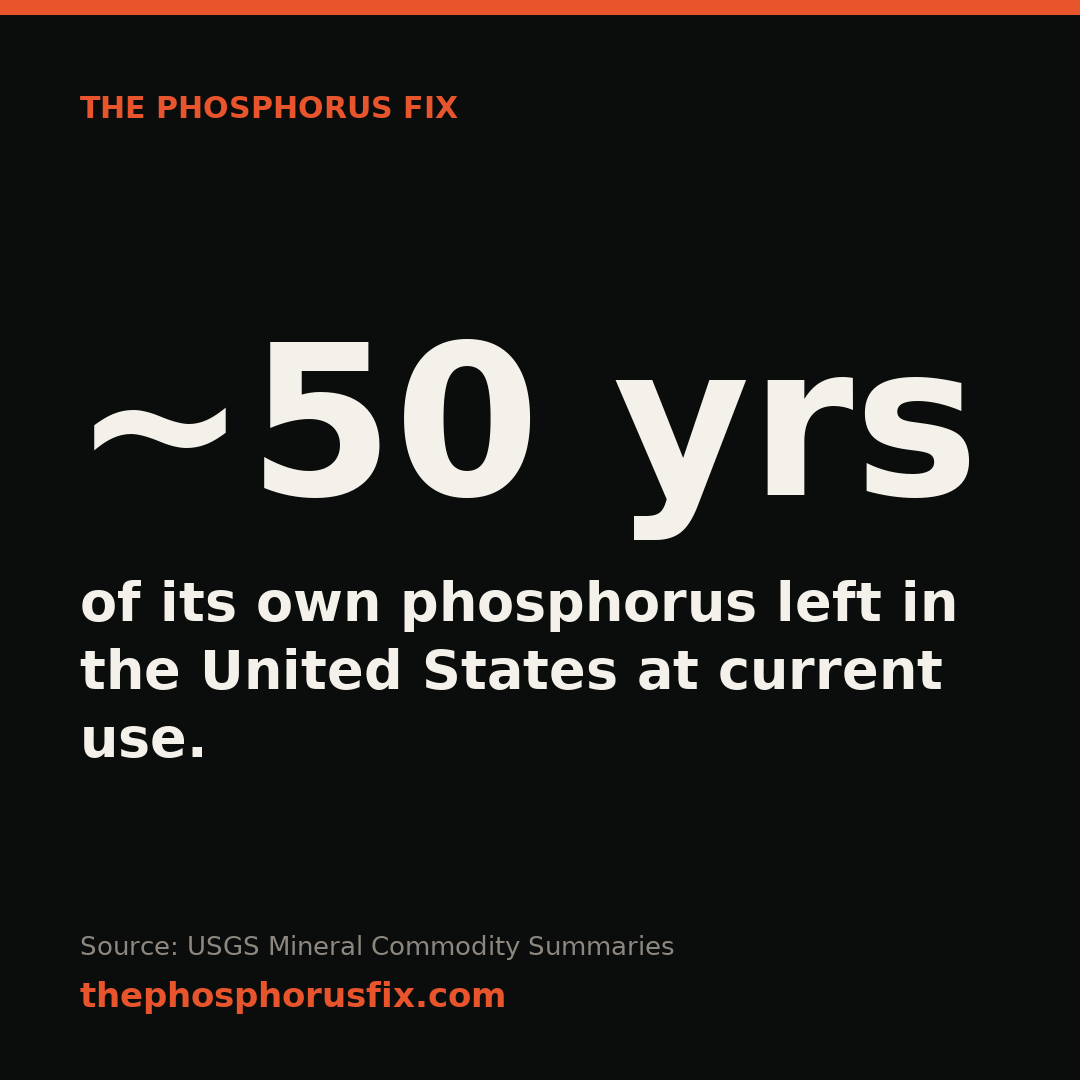
At the model's 20% first-season efficiency, US reserves last about half a century while most applied phosphorus is not recovered by the crop that season.
Model basis, not a measured national application total: 20 million metric tons of US phosphate rock per year × assumed 29% P₂O₅ grade = 5.8 million metric tons P₂O₅. At 20% first-season recovery, 5.8 × 80% = 4.64 million metric tons not recovered by the crop that season, displayed as 4.6. This simplified model treats domestic mined P₂O₅ as applied fertilizer; it excludes manure, imports, exports and processing losses. It is not a runoff estimate or a claim that residual phosphorus is permanently lost.
An efficiency gain is a supply gain. It needs no permit, no capital program and no decade of construction — and no foreign policy.
Efficiency chemistry is added where fertilizer is already handled — at the blend plant, in the planter, in the manure tank. No extra pass across the field.
The phosphorus has already been bought. This is about how much of it works, not about buying more.
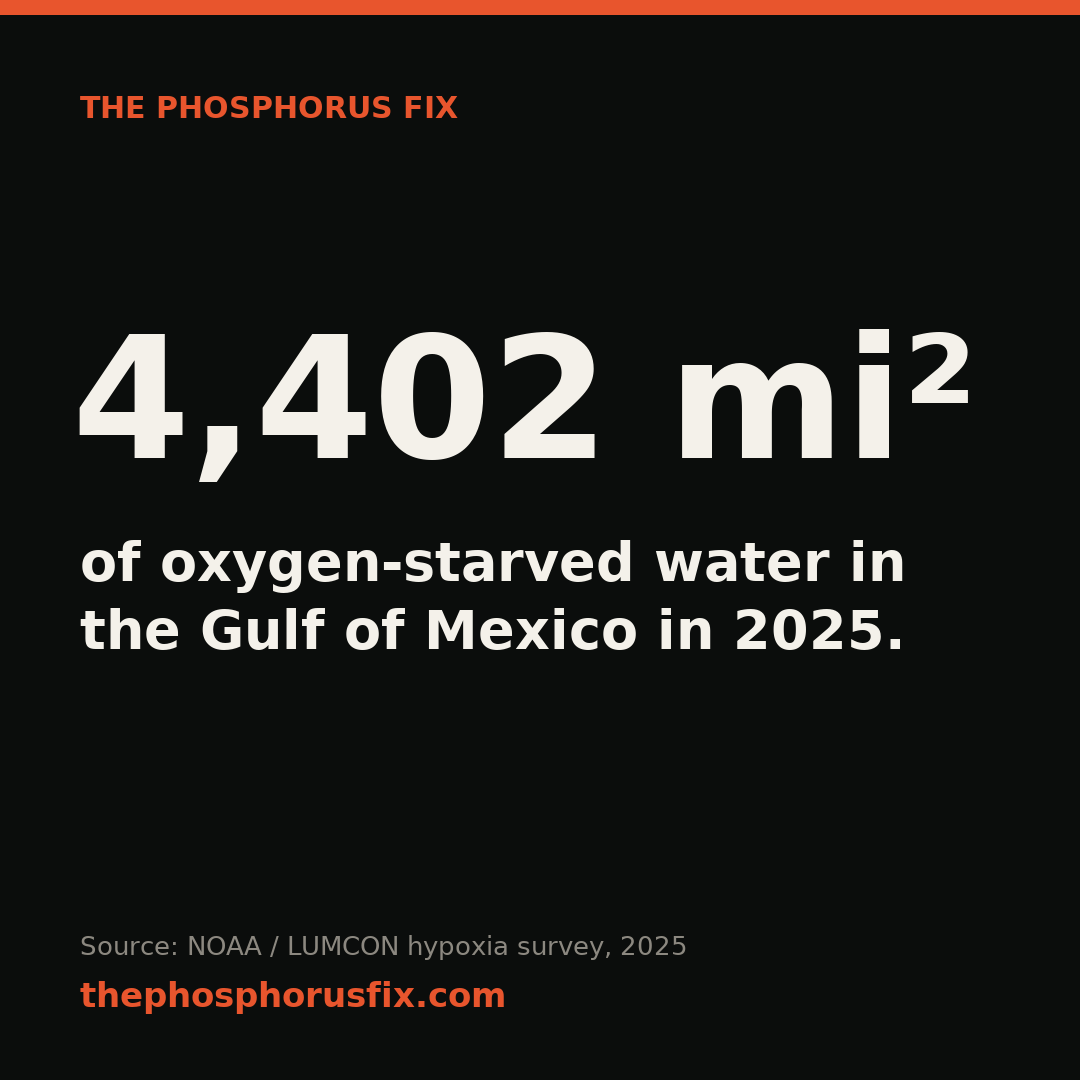
The 2025 Gulf hypoxic zone — more than 2.8 million acres where oxygen falls too low to support fish and shrimp. The five-year average is still more than double the federal 2035 target.
Mississippi Basin phosphorus loads are 13% above the 1980–96 baseline, while nitrogen is 28% below. Nitrogen management is working. Phosphorus is going backwards.
Phosphorus is the nutrient that drives freshwater algal blooms. In 2014 a toxic bloom on Lake Erie left roughly half a million people around Toledo unable to drink their water.
On US production alone, the CO₂e embodied in phosphorus that never feeds a crop runs to millions of metric tons a year — roughly 1.4 million cars. Every footprint is published per metric ton manufactured, never per metric ton a crop uses.
Phosphate rock is now a listed critical mineral. Use efficiency is the only lever that increases effective supply without a mine, a permit or a decade — and it currently sits outside the critical-minerals conversation entirely. Recognition costs nothing and changes the frame.
A measured state-level program — row-crop acres and livestock manure together — would produce the first hard figure for phosphorus recovered rather than imported. Open to any technology that can demonstrate the gain.
Nutrient management, watershed and conservation programs already measure phosphorus applied. None of them credit phosphorus made available. The measurement exists; the accounting does not.
Nitrogen has had a generation of innovation, attention and public investment — and nitrogen is the one nutrient we can make from thin air. Phosphorus, the finite one, was left to the mining industry.
If you work in agriculture, policy, water quality or food security, this belongs on your desk. Share it, challenge it, or help put a number on it.
Get in touchSuggested citation: The Phosphorus Fix, AgroTech USA, 2026. thephosphorusfix.com
Interviews and data questions: hello@thephosphorusfix.com
New data, state programs and policy moves. Rarely, and never shared.